























Billions of Galaxies Await as Roman Telescope Arrives for Launch

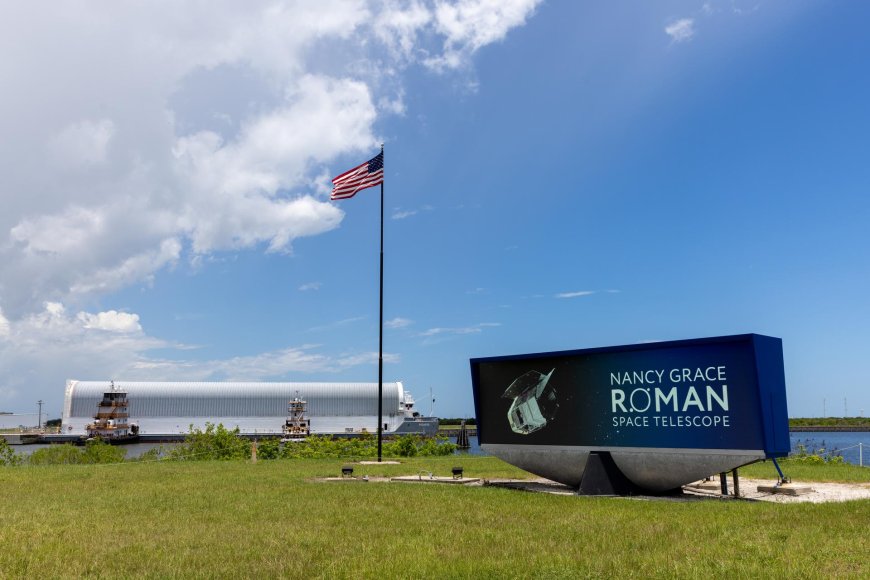
Photocourtesy - NASA/Amber Jean Notvest
NASA’s ambitious new space observatory, the Nancy Grace Roman Space Telescope, has arrived at the agency’s Kennedy Space Center, marking a major milestone ahead of its highly anticipated launch later this summer. The telescope reached Florida on June 21 aboard NASA’s Pegasus barge, beginning the final phase of testing, fueling, and launch readiness activities.
The observatory was transported from NASA Goddard Space Flight Center, where engineers completed a lengthy period of integration and testing. Carefully secured inside a climate-controlled transport container, the nearly 18,000-pound (8,200-kilogram) spacecraft was first moved to the Port of Baltimore before embarking on its sea journey along the Atlantic coast to Florida.
Upon arrival at Kennedy Space Center’s turn basin wharf, technicians offloaded the telescope and transferred it by truck to the Payload Hazardous Servicing Facility, a specialized processing center recently upgraded to support Roman’s final launch preparations. Teams will carry out extensive cleaning procedures to eliminate any contaminants accumulated during transit before moving the observatory into a controlled clean-room environment.
Over the coming weeks, engineers will conduct a series of critical checks to ensure the spacecraft is fully flight-ready. These include testing its six solar arrays, inspecting insulation and thermal protection systems, and loading approximately 290 gallons of hydrazine fuel into its tanks. Large cranes will then position the observatory on its processing platform for the final stages of launch integration.
NASA is targeting a launch date no earlier than August 30, 2026, aboard a SpaceX Falcon Heavy rocket from Launch Complex 39A at Kennedy Space Center. Remarkably, the mission is progressing about eight months ahead of its original schedule.
Following launch, Roman will journey to the second Sun-Earth Lagrange point, known as L2, a stable gravitational region located approximately 1.5 million kilometers from Earth. From this vantage point, the observatory will conduct some of the most expansive astronomical surveys ever attempted.
Equipped with a powerful 300-megapixel wide-field camera, Roman is expected to reveal billions of galaxies, discover hundreds of thousands of new exoplanets, and detect vast numbers of black holes. The mission will generate enormous volumes of scientific data, helping researchers explore fundamental questions about the universe, including the mysterious force driving its accelerated expansion.
The telescope will also demonstrate advanced starlight-blocking technology designed to directly image exoplanets and planet-forming disks, paving the way for future missions searching for potentially habitable worlds.
Interestingly, the Pegasus barge’s latest voyage carried more than just the Roman telescope. It also transported a weather cover for the Space Launch System core stage that will support the Artemis III mission. By combining cargo for two major programs, NASA maximized transportation resources while advancing both deep-space science and lunar exploration initiatives, underscoring a new era of innovation and discovery for the agency.
What's Your Reaction?