





Rise of the Robo-Muse: Inside the Creative World’s Biggest Disruption Yet
Rise of the Robo-Muse: Inside the Creative World’s Biggest Disruption Yet

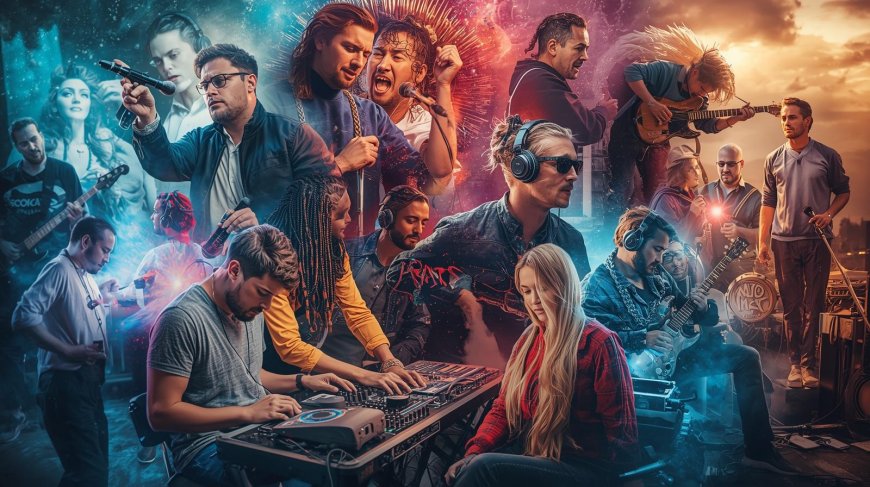
Lucknow: In neon-lit studios of Mumbai and the quiet lofts of Lucknow, a revolution hums—not with paintbrushes or chisels, but with algorithms, neural networks, and immersive realities. Technology is no longer a mere instrument in the artist’s kit; it is the kiln reshaping the very clay of creativity. From AI-spun symphonies to blockchain-secured brushstrokes, the creative arts are witnessing a seismic shift so dramatic that even Picasso might pause mid-stroke. As Anant Goenka, Executive Director of the Indian Express Group, puts it: “We’re not replacing artists—we’re giving them superpowers.”
Welcome to the new Renaissance, where code has become the muse.
Generative AI: The New Prometheus
Leading the charge is Generative AI, the Prometheus pulling fire straight from the gods of imagination. Tools like Midjourney, Stable Diffusion and India’s own Krea—valued at $120 million after its Series B in October 2025—allow creators to conjure hyper-realistic visuals from a single line of text.
Lucknow-based digital artist Priya Ranjan, 29, whose AI-augmented mural illuminated the Gomti Riverfront during Diwali, recounts: “I typed ‘Nawabi cyberpunk under a blood moon,’ and my childhood sketches evolved into something unimaginable.” Her NFT series, sold for ₹18 lakh on Objkt, represents a growing wave: the collapse of the gap between imagination and execution.
Traditionalists disagree. Veteran painter Jogen Chowdhury has famously dismissed AI as “a parrot with a photogenic memory—it mimics, it doesn’t bleed.” Yet the numbers paint a decisive picture. DALL-E 3 crossed 15 million users in Q3 2025, and 42% of them are professional artists using the tool for ideation.
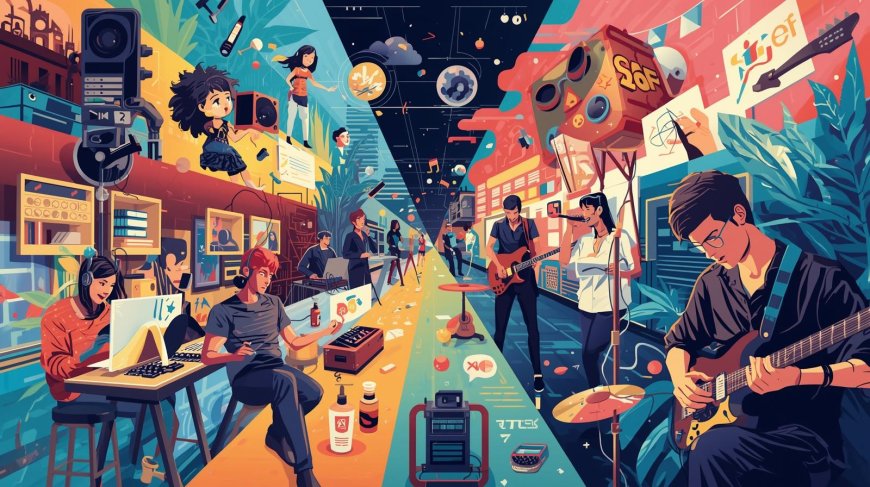
VR/AR: Dismantling the Fourth Wall
Virtual and Augmented Reality are rewriting how audiences meet art. At the Kochi-Muziris Biennale 2025, visitors wearing Apple Vision Pro headsets stepped inside Subodh Gupta’s stainless-steel installations—floating utensils whispering migration stories in Malayalam. “VR isn’t a gimmick—it’s the new proscenium arch,” says curator Bose Krishnamachari.
Meanwhile, Delhi’s Aerocity is set to host South Asia’s largest persistent metaverse gallery. Built by collective Immersive India, funded with ₹32 crore, the platform lets avatars bid on digital sculptures using Polygon blockchain. India’s digital art market, valued at ₹450 crore in 2024, is projected to hit $1.2 billion by 2027.
Classical traditions are evolving too. Bharatanatyam exponent Alarmél Valli partnered with IIT Madras to map mudras onto holographic avatars, preserving endangered gestures for global classrooms. “Technology is the new guru,” she says.
Blockchain & NFTs: Reinventing Provenance
Forgery scandals are fading as blockchain reshapes provenance. Platforms like Hic et Nunc India embed cryptographic certificates in every pixel of a digital artwork. In March 2025, Mumbai gallerist Dadiba Pundole sold a digital MF Husain for $2.1 million—“The buyer never touched the canvas but owns it forever,” he marvels.
Smart contracts, meanwhile, ensure fairer monetisation. A street artist from Kolkata’s Kumartuli now earns 5% every time her Ganesh idol NFT changes hands. Almost half of India’s NFT creators in 2025 were under 30—and 61% were women.
Music Reimagined: When Code Composes
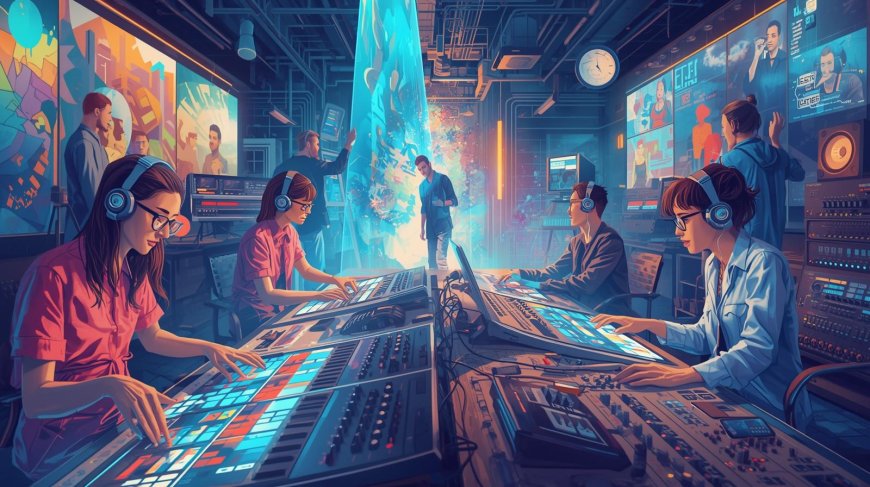
The melody of the future vibrates with code. AIVA (Artificial Intelligence Virtual Artist) composed the score for Netflix India’s The Last Kebab, while Hyderabad’s Muzeek AI lets independent musicians generate tabla loops across 47 raags. A.R. Rahman, an early investor, predicts: “In five years, every film will have an AI co-composer—human ego will be the only bottleneck.”
Holographic concerts are redefining the stage. At a popular fest, a resurrected Lata Mangeshkar—powered by AI, choreography, and volumetric capture—performed a duet with Shreya Ghoshal to a stunned audience of 45,000.
3D Printing, Robotics & AI Theatre
3D printing has entered the atelier. Students at NID Ahmedabad are using mycelium and rice husk to print biodegradable sculptures, reducing waste by nearly 87%. Bengaluru’s Grayparrot Robotics is helping muralists paint 40-foot walls with drone precision, shrinking production time from weeks to hours.
At Prithvi Festival 2025, AI actors performed alongside humans, powered by GPT-5 fine-tuned on 400 Marathi plays. “The machine surprised us with a monologue on climate grief—raw, unscripted. We kept it,” says director Sunil Shanbag.
The Shadow Side: Ethics, Jobs & Energy
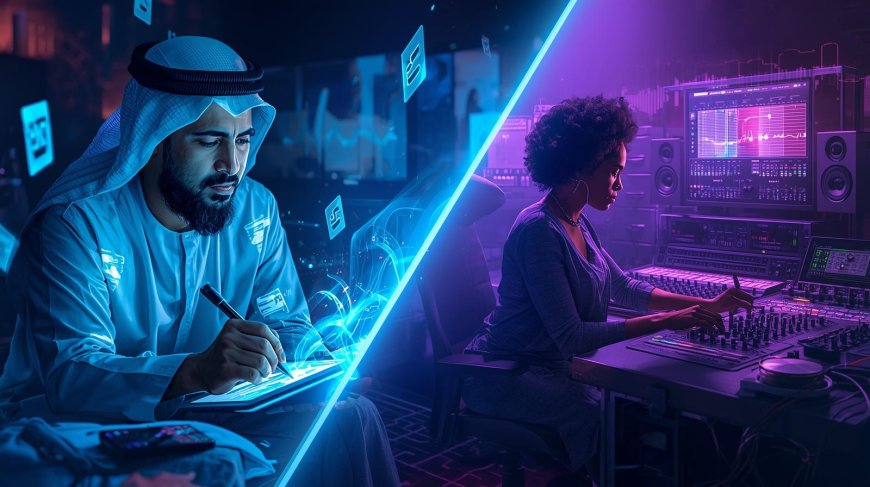
But every revolution casts shadows. Job insecurity haunts young animators as tools like Runway ML automate complex video generation. Copyright disputes are escalating—especially after the Delhi High Court ruled in August 2025 that AI-generated art lacks “human authorship.”
Opaque datasets deepen the controversy. A MIT Technology Review audit found that over 70% of Stable Diffusion’s training corpus is unlicensed. And the environmental toll is real: generating a single 4K AI image consumes the energy equivalent of charging 12 smartphones.
Priya Ranjan sums it up perfectly: “I’m not afraid of AI stealing my job. I’m afraid of not evolving with it.”
The canvas is infinite. The future is already rendering.
What's Your Reaction?