

















UP’s 2040 Vision: AI Economy, Rural Internet, and Industrial Boom

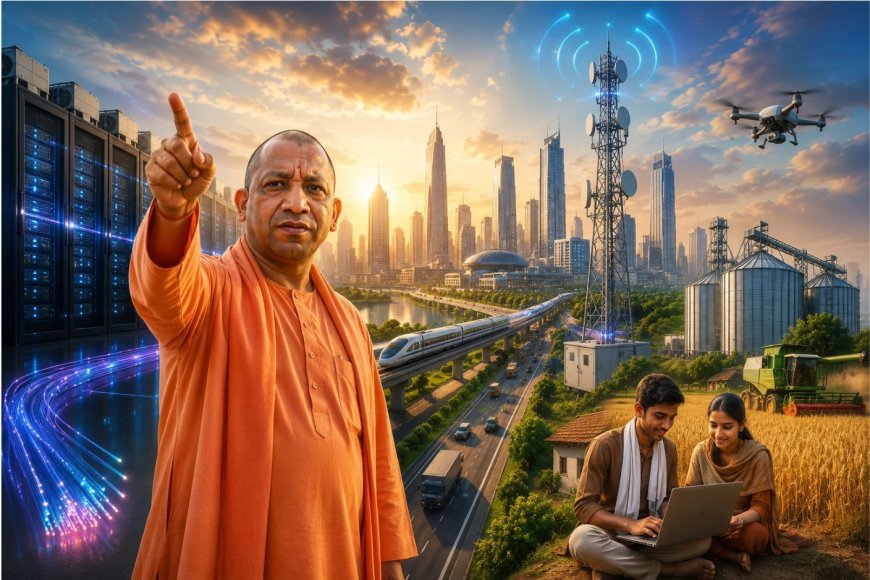
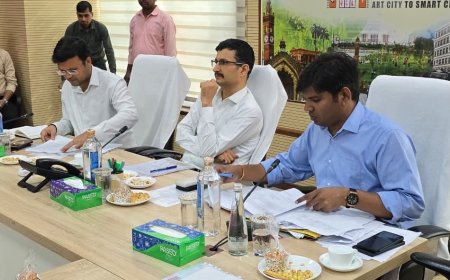
In a high-level review meeting held in Lucknow, Chief Minister Yogi Adityanath outlined an ambitious roadmap aimed at transforming Uttar Pradesh into a global hub for artificial intelligence, data infrastructure, and digital economy. The discussions focused on three key initiatives—Uttar Pradesh Data Center Cluster (UPDCC), Project Ganga, and the state’s wheat processing policy—signaling a major push toward a future-ready economy.
The Chief Minister emphasized that the Data Center Cluster project will serve as the backbone of Uttar Pradesh’s AI mission. He directed officials to expand the initiative beyond the NCR region and integrate other parts of the state as well. The Bundelkhand Industrial Development Authority (BIDA) region was suggested as a starting point due to its large land availability. He also called for engagement with major technology groups, including Tata Group, to develop Lucknow as an emerging “AI City.”
According to the presentation, the project aims to position Uttar Pradesh as India’s—and potentially the Global South’s—largest AI compute power hub. The long-term vision includes building a $5 trillion economy by 2040, generating over 150,000 direct jobs, and establishing a 5 GW AI compute corridor.
Officials also highlighted that the global economy of the future will be driven by AI, cloud computing, cybersecurity, semiconductors, electric vehicles, robotics, and space technology—an ecosystem valued between $29 trillion and $48 trillion. Uttar Pradesh aims to secure a strong position within this emerging global landscape.
Project Ganga: Digital Transformation of Rural UP
The Chief Minister also reviewed “Project Ganga” (Government Assisted Network for Growth and Advancement), an ambitious initiative aimed at expanding high-speed broadband connectivity across rural Uttar Pradesh. He stressed the importance of transparent execution and skill-based training for selected digital entrepreneurs.
The project plans to develop over 10,000 Digital Service Providers (DSPs), who will deliver broadband connectivity along with services such as telemedicine, digital education, e-governance, and rural digital employment. Nearly 20 million households are expected to be connected through fiber networks, with a strong emphasis on women-led entrepreneurship, targeting 50% participation.
Each DSP will be supported with interest-free loans of up to ₹5 lakh, enabling grassroots-level digital entrepreneurship and service delivery.
Focus on Wheat Processing and Food Security
The Chief Minister also reviewed strategies to promote in-house wheat processing and modernize mandi (market) systems. He called for cleaner, better-managed, and more modern mandis across the state.
Uttar Pradesh, India’s largest wheat-producing state, is expected to produce around 372 lakh metric tonnes of wheat in 2025–26, with total availability reaching approximately 407 lakh metric tonnes. However, limited local processing capacity results in large volumes of wheat being exported to other states, reducing value addition, tax revenue, and local employment opportunities.
The state currently has 559 roller flour mills with a total milling capacity of 218.4 lakh metric tonnes, though actual utilization remains significantly lower. Additionally, over 40,000 flour mills operate across Uttar Pradesh.
What's Your Reaction?