
























Rare Supernova’s Power Source Finally Comes Into Focus

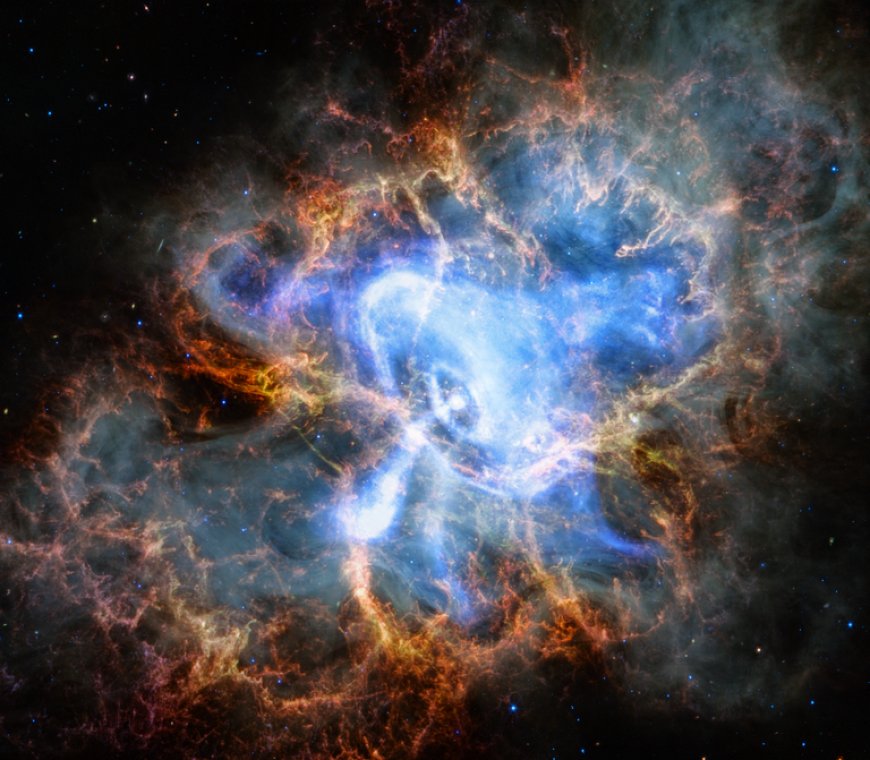
An international team analyzing data from NASA’s Fermi Gamma-ray Space Telescope has reported a remarkable discovery that sheds new light on one of the universe’s most powerful stellar explosions. The mission appears to have captured signals from a rare, exceptionally luminous supernova, likely energized by an ultra-magnetic neutron star formed in the aftermath of a collapsing star.
The findings suggest that this extraordinary explosion, known as a superluminous supernova, may have been powered by a “magnetar”—a type of neutron star with an extremely strong magnetic field. These objects are among the most extreme in the universe, capable of influencing surrounding matter and radiation in dramatic ways.
The study, led by researchers including Fabio Acero of the French National Centre for Scientific Research (CNRS) and the University of Paris-Saclay, highlights years of effort to detect gamma-ray signals from supernovae. While scientists have long suspected such emissions, this marks one of the clearest indications yet that they can be observed.
The supernova at the center of the study, SN 2017egm, occurred in a galaxy approximately 440 million light-years away in the constellation Ursa Major. First discovered in 2017, it stood out for its unusual brightness—far exceeding that of typical stellar explosions.
By combining optical and gamma-ray data, researchers found evidence suggesting that the explosion’s extreme energy output could be explained by a rapidly spinning newborn magnetar. These exotic remnants are formed when massive stars collapse, leaving behind dense cores no larger than a city but packing more mass than the Sun.
According to the research team, the magnetar may have been spinning hundreds of times per second shortly after its formation. This rapid rotation would have generated intense streams of charged particles, forming a powerful “wind” that interacted with the expanding debris of the exploded star.
These interactions are believed to produce high-energy gamma rays. In some cases, the radiation becomes trapped within the expanding cloud of debris, later transforming into visible light that enhances the supernova’s brightness.
Scientists believe that around three months after the explosion, the surrounding material becomes thin enough for gamma rays to begin escaping. This timing matches the signals detected by Fermi’s Large Area Telescope, strengthening the case for the magnetar-powered model.
Researchers also noted that while the magnetar explanation fits much of the observed data, additional processes—such as fallback material or collisions with earlier stellar ejecta—may have influenced the supernova’s long-term fading behavior.
The study also points to future possibilities. Next-generation ground-based observatories, such as the Cerenkov Telescope Array, could detect similar events across even greater distances, helping scientists build a more complete understanding of how such powerful explosions evolve.
NASA officials say this discovery opens a new observational window into the inner mechanics of supernovae, offering deeper insight into how some of the most energetic events in the cosmos are powered and sustained.
What's Your Reaction?