


















The Silent Disruptor: Lucknow’s Rise in India’s New Tech Geography
The Silent Disruptor: Lucknow’s Rise in India’s New Tech Geography

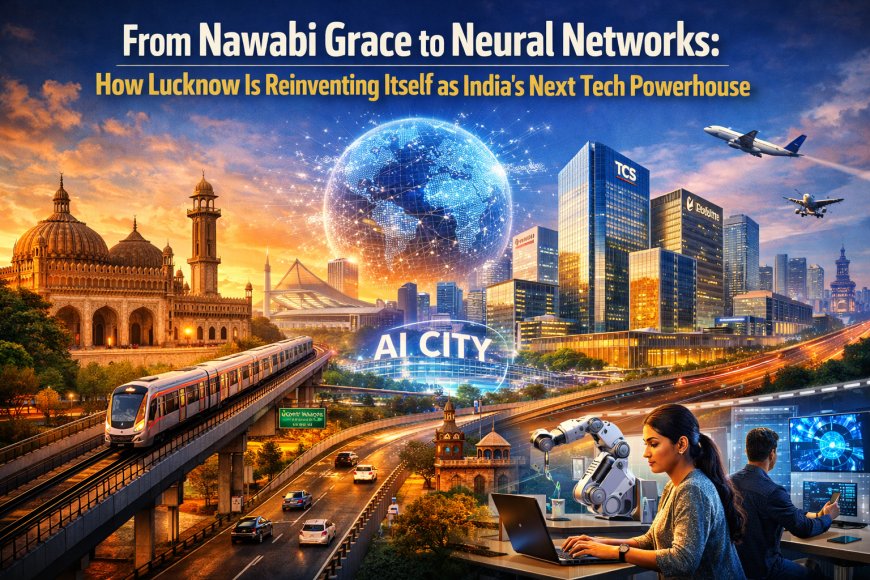
Lucknow: Lucknow is no longer content being remembered only as the City of Nawabs. Revered for its tehzeeb, Awadhi cuisine, and timeless architecture, the capital of Uttar Pradesh is now scripting a far more ambitious future—one powered by technology, capital, and scale. As of January 2026, Lucknow stands at the cusp of a historic transformation, rapidly evolving into a high-growth business and technology district that is beginning to draw comparisons with India’s established IT giants such as Bengaluru, Hyderabad, and Pune.
This is not incremental change. It is structural, policy-driven, and unmistakably strategic.
At the heart of this shift lies Gomti Nagar and its expanding extensions, now firmly established as Lucknow’s central business district. Glass-fronted offices rise alongside cultural landmarks, global corporations move in next to start-ups, and a city once defined by royal courts now hosts boardrooms, data centres, and AI labs. Lucknow’s old-world charm remains intact—but it is now matched by modern ambition.
Infrastructure First: Building the Spine of a New Economy
Lucknow’s reinvention rests on a foundation of world-class infrastructure, aggressively expanded over the past five years.
The Chaudhary Charan Singh International Airport has emerged as a critical aviation gateway for North India. Managed by Adani Airports, the ₹2,400-crore Terminal 3—completed in 2024—has taken annual passenger capacity beyond eight million. Phase 2, already in motion, will push this figure to 13–14 million by 2026–27. With an additional ₹10,000 crore earmarked for expansion, including international connectivity and cargo logistics, Lucknow is positioning itself as a regional aviation and trade hub.
Urban mobility is undergoing a parallel overhaul. The Lucknow Metro’s Phase-1B expansion, with an investment of ₹5,801 crore, will add over 11 km of track and 12 new stations—many underground—linking heritage zones like Aminabad and Chowk directly to Gomti Nagar and the airport. This integration of history with high-speed connectivity reflects the city’s broader transition.
Meanwhile, expressway infrastructure—Agra–Lucknow, Purvanchal, and the upcoming Lucknow–Kanpur corridor—has drastically cut travel times, anchoring Lucknow as the geographic and economic nerve centre of Uttar Pradesh.
Real Estate Signals the Shift
Markets often move before narratives—and Lucknow’s real estate numbers tell a compelling story. Gomti Nagar Extension has witnessed land price appreciation of nearly 79 percent between 2020 and 2025, with year-on-year growth crossing 22 percent in 2025 alone. Commercial developments such as Omaxe Hazratganj, Eldeco Trinity, and The Galleria are reporting strong absorption rates, rental yields of 3–5 percent, and projected annual appreciation of up to 15 percent through 2026.
Investors, both institutional and retail, are clearly betting on Lucknow’s future as a sustained commercial destination rather than a speculative play.
Policy Power: Uttar Pradesh’s GCC and Tech Push
What sets Lucknow apart from many Tier-2 aspirants is policy muscle.
The Uttar Pradesh Global Capability Centres (GCC) Policy 2024—operationalised through Rules-2025 in January this year—offers one of India’s most aggressive incentive frameworks. These include land cost subsidies of up to 50 percent, full stamp duty exemption, capital subsidies reaching ₹25 crore, operational support up to ₹80 crore, payroll incentives for local hiring, and R&D grants of up to ₹10 crore.
The goal is explicit: attract Fortune 500 companies and leading Indian enterprises, and create more than two lakh high-value jobs within five years.
Principal Secretary (Planning) Alok Kumar summed it up succinctly: Uttar Pradesh is positioning itself as one of the world’s most competitive GCC destinations. Companies such as Microsoft, Adobe, Infosys, Wipro, HCL, IBM, JP Morgan, Teleperformance, and TCS already have a footprint across Lucknow and the Noida–Greater Noida belt.
Complementing this push are the state’s Data Centre Policy and IT-ESDM initiatives, targeting investments of ₹70,000 crore. According to Industrial Development Minister Nand Gopal Gupta Nandi, investment momentum under the GCC framework is accelerating, with over 20 companies initiating projects in the current financial year alone.
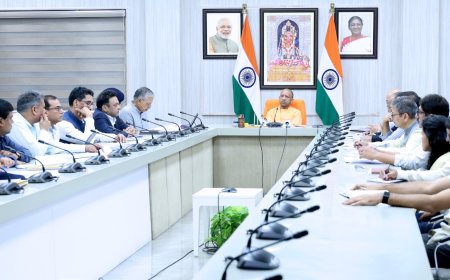
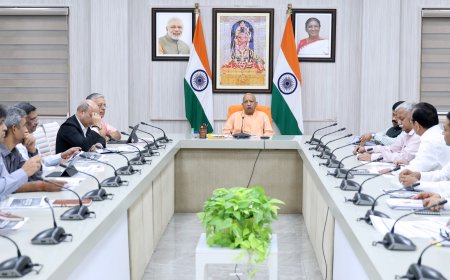
Chief Minister Yogi Adityanath has called 2026 a “defining year,” openly pitching Uttar Pradesh—and Lucknow in particular—as India’s next AI and technology hub, aligned with the state’s ambition of becoming a $1-trillion economy.
The Crown Jewel: India’s First AI City
Nothing symbolises Lucknow’s leap into the future more powerfully than India’s first AI City.
Proposed by Tata Group Chairman N. Chandrasekaran in December 2025, the project is advancing rapidly under a public-private partnership model. Spread across land near the Defence Expo site, the AI City will be developed in two phases and powered entirely by green energy, including solar and green hydrogen.
Backed by a ₹10,732-crore corpus, the project will house AI-first enterprises, global capability centres, incubation hubs, research labs, and hyperscale data centres. The ambition is global: position Lucknow among the world’s top 20 AI hubs.
Tata Consultancy Services plans to expand its workforce in Lucknow and Noida from over 16,000 to more than 30,000, significantly deepening the city’s digital talent pool. As one senior official put it, the AI City is designed to be “self-reliant, future-ready, and globally competitive.”
Corporates Follow Capital
The corporate response has been swift.
Deloitte’s entry into Gomti Nagar—the first Big Four firm to set up shop in Lucknow—marks a psychological turning point. Its Vibhuti Khand office is expected to generate up to 1,000 high-skill jobs in the initial phase. Other major players, including HCL, IBM, Capgemini, Genpact, Nagarro, and Sify Infinit Spaces, are expanding operations, while startups are flourishing through incubators that have already generated tens of thousands of jobs.
Industry leaders note that Lucknow’s advantage lies not just in cost efficiency, but in balance: access to talent from institutions like IIM Lucknow and IIT Kanpur, a strong quality of life, and a cultural ethos that retains its warmth even as the city modernises.
A City Rewritten
Lucknow’s story today is neither nostalgic nor speculative. It is unfolding in real time, powered by infrastructure, sharpened by policy, and validated by capital.
From nawabi courts to neural networks, from tehzeeb to technology, Lucknow is redefining what an Indian growth city can look like—inclusive, sustainable, and unapologetically ambitious. The silent disruptor is no longer whispering. It is ready to lead.
What's Your Reaction?