





















Smartboards and the Silent Digital Revolution Transforming India’s Classrooms
Smartboards and the Silent Digital Revolution Transforming India’s Classrooms

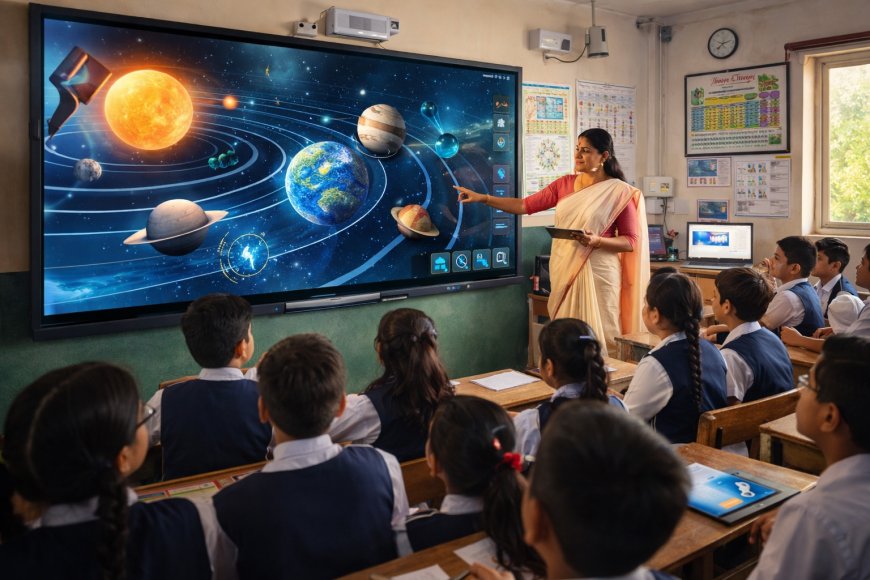
Lucknow: In the bustling classrooms of India—where over 24.8 crore students study across nearly 14.72 lakh schools—a quiet yet powerful digital revolution is unfolding. The familiar haze of chalk dust and rows of blackboards are steadily being replaced by smartboards: interactive digital displays that combine touchscreen technology, multimedia content, and internet connectivity. These tools are reshaping how knowledge is delivered and absorbed, marking a decisive shift in India’s education ecosystem.
Smartboards enable teachers to move beyond static lectures into immersive, interactive teaching. Videos, animations, simulations, real-time quizzes, and 3D models now coexist with traditional pedagogy, making classrooms more participatory. This transformation aligns closely with the National Education Policy (NEP) 2020, which places strong emphasis on technology integration, experiential learning, and critical thinking. In a post-pandemic era where digital literacy is no longer optional, smartboards are helping bridge learning gaps and future-proof students.
Government investment has been a key driver of this shift. Delhi emerged early as a frontrunner, announcing plans to install smartboards in over 20,000 classrooms. During a school visit in 2022, former Delhi Education Minister Manish Sisodia remarked that “all these smart boards are equipped with state-of-the-art technology that will not only make the teaching-learning process joyful, but also help children learn better,” adding that students would be able to revisit recorded lessons using integrated cameras and online resources.
By 2025, access to computers in Indian schools rose from 38.5 percent in 2019–20 to 57.2 percent, while internet availability reached nearly 54 percent, creating fertile ground for smart classrooms. Karnataka followed suit by converting around 8,000 government college classrooms into smart classrooms with high-speed internet and tablets, while other states accelerated similar initiatives.
Private schools have also embraced digital learning at scale. Institutions like Seth M.R. Jaipuria School, K.R. Mangalam World School in Lucknow have equipped classrooms with high-tech projectors, digital boards, learning management systems, coding labs, and even virtual reality modules. These innovations are redefining classroom engagement by turning abstract concepts into immersive experiences.
Research strongly supports this shift. Studies by IIT Bombay and NCERT indicate that smartboards significantly enhance student motivation, engagement, and learning outcomes. A report cited by The Manthan School in Noida notes, “Research has shown that the use of smart boards leads to improved student outcomes, including increased achievement, higher levels of engagement, and better retention of information.”
On the ground, educators echo these findings. At Victorious KidssEducares in Pune, PixelEdge smartboards supplied by SHARP India have transformed classroom dynamics. Secondary School Principal ReneeshDevasia explains, “The integration of PixelEdge Smartboards has brought about a transformation in the way teaching and learning take place.” He adds that features like drag-and-drop tools, interactive graphs, and multimedia simulations allow teachers to go “beyond what really happens in a traditional classroom,” enabling students to engage deeply with real-world case studies.
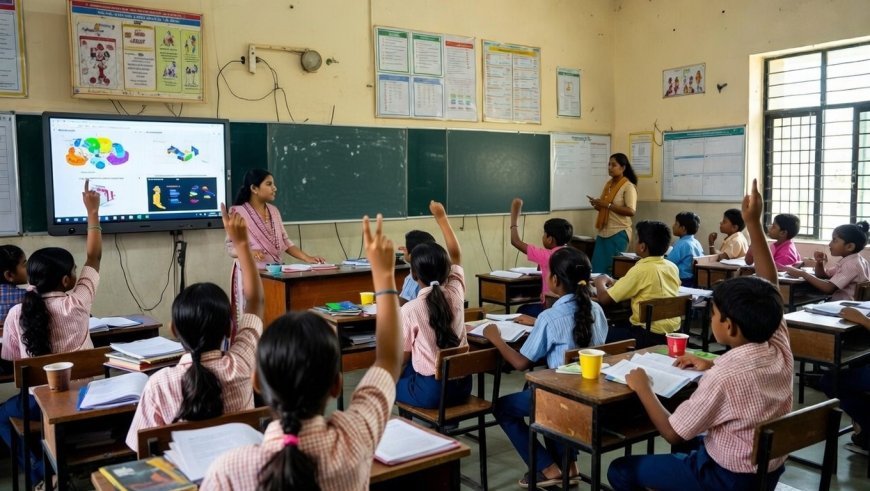
The impact is particularly profound in government schools, where smartboards are helping narrow the urban-rural divide. The Hindustan Coca-Cola Beverages (HCCB) initiative, in partnership with the Y4D Foundation, installed digital smartboards in 100 schools across 10 states by 2025, benefiting nearly 15,000 students. In Andhra Pradesh, education reforms famously described the shift as moving “from chalkboards to smartboards,” aiming to deliver world-class education and lift students “from poverty to possibility.”
Delhi’s renewed push underscores the scale of ambition. In 2025, Education Minister Ashish Sood announced a ₹900 crore investment to add 4,000 smart classrooms every year until 2029–30. Criticising earlier delays, he stated, “This is the first major step to make Delhi’s government schools better than private ones.”
Beyond engagement, smartboards are advancing inclusivity. Features such as voice recognition, subtitles, cloud-based content sharing, and offline servers ensure access for visually impaired students and those in remote areas with poor connectivity. Ministry reports indicate that interactive learning environments have also helped improve attendance and reduce dropout rates.
However, challenges persist. Reports show that many schools use less than 20 percent of smartboard capabilities due to inadequate teacher training. Education leaders stress the need for continuous professional development to prevent technology from becoming underutilised. Some experts caution against over-digitisation, warning that excessive screen use could affect deep thinking if not balanced with human interaction.
Looking ahead, NEP 2020 envisions smartboards integrated with artificial intelligence for personalised learning and experiential education. National initiatives aimed at upgrading schools with digital labs and innovation-driven curricula are reinforcing this vision. As Dr. Manju Gupta, Pro Vice-Chancellor at EIMT Switzerland, aptly puts it, “The future of learning lies in blending technology with empathy, creativity, and lifelong learning.”
What's Your Reaction?