








A New Generation Takes Charge: Nitin Nabin and the BJP Reset
A New Generation Takes Charge: Nitin Nabin and the BJP Reset

New Delhi: When the Bharatiya Janata Party announced Nitin Nabin as its new national president, the decision carried a significance far beyond a routine change of guard. At just 45, Nabin became the youngest-ever national president of the BJP—the world’s largest political party by membership—signalling a decisive generational shift. His rise encapsulates the BJP’s preferred narrative: a journey from booth-level politics to the very top, powered not by flamboyance or entitlement, but by discipline, organizational skill, and relentless hard work.
In many ways, Nitin Nabin’s elevation reflects the party’s evolution under Prime Minister Narendra Modi and Home Minister Amit Shah—an organization that prizes execution, loyalty, and electoral effectiveness as much as ideology.
Roots in Politics, Lessons from Loss
Born as Nitin Nabin Sinha on May 23, 1980, in Ranchi (then part of undivided Bihar, now Jharkhand), Nitin grew up in a household where politics was not an abstraction but a way of life. He belongs to a Hindu Chitraguptavanshi Kayastha family, traditionally associated with administration, law, and governance. His father, the late Nabin Kishore Prasad Sinha, was a respected BJP stalwart and a four-time MLA from Patna West and Bankipur. At a time when the BJP was still building its base in Bihar, Nabin Kishore was known for his strong grassroots connect and tireless organizational work in urban Patna.
The family eventually settled in Patna, where young Nitin was exposed early to party meetings, campaigns, and the grind of electoral politics. His mother, Meera Sinha, ensured stability at home, balancing the demands of public life with family discipline.
The defining moment came in 2006, when Nitin was just 26. His father’s untimely death created both a personal void and a political challenge. Instead of retreating, Nitin stepped forward, contesting the Patna West by-election on a BJP ticket. His victory was not merely symbolic; it marked his transformation from a political heir into an independent leader, tested early by responsibility and public scrutiny.
Education, Family, and a Grounded Persona
Nitin Nabin completed his Class 12 education in 1998 from C.S.K.M. Public School, New Delhi (CBSE). While there are references to his association with Kirori Mal College, Delhi University, his official affidavits list him as 12th pass. In a political culture often obsessed with degrees, Nabin’s rise underscores a different pathway—one built on experiential learning, organizational intuition, and political discipline rather than academic pedigree.
He is married to Deepmala Shrivastava, a businesswoman and Director of Navira Enterprises. The couple has two children, and despite his high office, Nitin Nabin has kept his family largely away from the political spotlight. Occasionally, glimpses—such as Prime Minister Modi’s affectionate interaction with his children at a public event—have gone viral, offering a rare, humanizing peek into his private world.
Party colleagues describe him as family-oriented, punctual, and personally austere. Away from politics, he is known to enjoy Bollywood cinema and is reportedly a fan of Madhuri Dixit—small details that soften the image of an otherwise intensely focused organizational man.
Building a Base: The Bankipur Years
After his 2006 by-election victory, Nitin Nabin went on to become one of Bihar BJP’s most consistent electoral performers. He has been elected five times as MLA from Bankipur, one of Patna’s most politically significant urban constituencies. Bankipur, with its mix of traders, professionals, students, and middle-class voters, has long been considered a barometer of urban political sentiment in Bihar.
Under Nabin’s stewardship, the constituency evolved into a stronghold of booth-level organization. His accessibility, attention to civic issues, and ability to mobilize workers turned Bankipur into a model seat for the BJP’s urban strategy in eastern India.
As a legislator, he built a reputation for being present and responsive—traits that helped him survive multiple political cycles in a state known for volatile alliances and shifting loyalties.
Executive Experience in a Complex State
Nitin Nabin’s rise was not confined to electoral success alone. In successive NDA governments in Bihar, led by Chief Minister Nitish Kumar, he was entrusted with significant ministerial portfolios, including:
-
Minister of Road Construction (PWD)
-
Minister of Urban Development and Housing
-
Minister of Law and Justice
These roles placed him at the heart of Bihar’s governance challenges. As PWD minister, he oversaw key road and infrastructure projects that contributed to improved connectivity in urban and semi-urban areas. In urban development, he dealt with housing, municipal reforms, and modernization initiatives at a time when Bihar’s cities were undergoing demographic and economic transition.
Perhaps most importantly, navigating governance in Bihar required political finesse. Coalition compulsions, administrative inertia, and regional sensitivities tested his ability to balance policy execution with political negotiation—experience that would later prove invaluable at the national organizational level.
The Organizational Man
If electoral victories gave Nitin Nabin legitimacy, it was his organizational mastery that propelled him to the BJP’s apex. Starting as a booth-level worker, he rose through the ranks of the Bharatiya Janata Yuva Morcha (BJYM), developing a keen understanding of youth mobilization, cadre management, and election logistics.
Unlike leaders who build public profiles through rhetoric, Nabin focused on systems—strengthening booth committees, ensuring discipline among workers, and delivering results quietly. His effectiveness did not go unnoticed. He was entrusted with organizational responsibilities in states like Chhattisgarh, where he played a key role during assembly and Lok Sabha elections.
His style mirrored the Modi–Shah template: low on noise, high on execution; emphasis on coordination (samanvay), data-driven planning, and accountability. In December 2025, he was appointed National Working President, widely seen as a clear signal of succession.
The Top Job
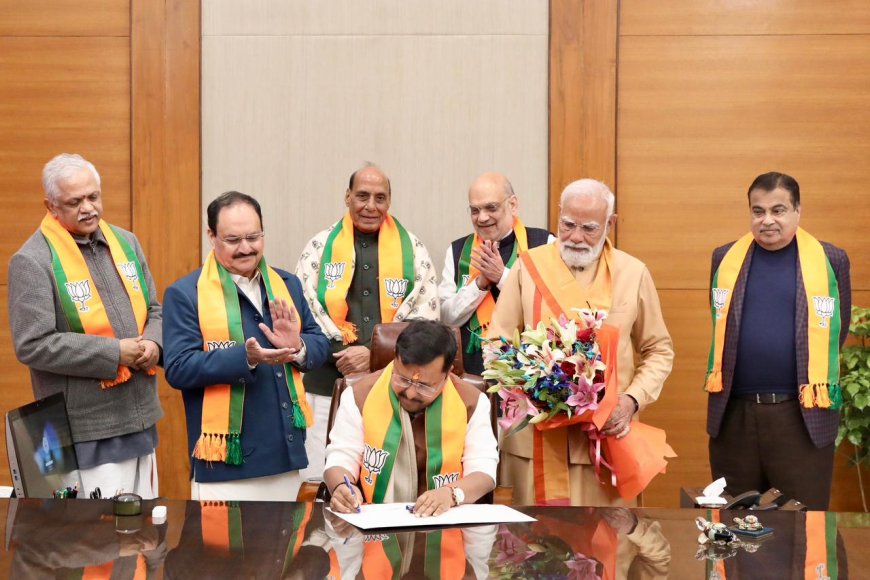
On January 19–20, 2026, Nitin Nabin was elected unopposed as the 16th National President of the BJP. His nomination papers were proposed and endorsed by the party’s tallest figures—Prime Minister Narendra Modi, Home Minister Amit Shah, Defence Minister Rajnath Singh, Nitin Gadkari, and outgoing president J.P. Nadda.
At the ceremony, PM Modi jokingly referred to Nitin Nabin as his “boss” in party matters, praising him as a leader who combines youth with experience. The message was deliberate: the BJP was investing in the next 25 years, aligning leadership transition with its vision of a “Viksit Bharat” by 2047.
Style, Critics, and the Road Ahead
As party president, Nitin Nabin is seen as accessible, tireless, and intensely party-first. His Kayastha background—often viewed as administratively neutral—may help him bridge caste and regional divides. He is not a mass orator, nor does he seek constant media attention. Instead, he operates as a coordinator-in-chief, focused on strengthening the party machine.
Challenges, however, are formidable. Assembly elections loom in Assam, West Bengal, Kerala, Tamil Nadu, and Puducherry, followed by the politically crucial Uttar Pradesh elections in 2027 and the 2029 Lok Sabha polls. Expanding the BJP’s footprint in the South and East, countering opposition narratives, and integrating younger leaders without disrupting ideological coherence will test his leadership.
Critics argue that his appointment ensures continued centralized control under the Modi–Shah axis, with a low-profile president acting as an enabler. Supporters counter that his journey—from booth worker to national president—is proof of the BJP’s meritocratic ethos, sharply contrasting with dynastic politics elsewhere.
A Quiet Symbol of a Big Transition
Nitin Nabin’s story is not dramatic in the conventional sense. There are no sudden ideological ruptures or charismatic flourishes. Instead, it is a narrative of steady ascent—of learning politics from the ground up, surviving early loss, mastering organization, and earning trust through results.
In an era dominated by spectacle and soundbites, his rise underscores a quieter truth of Indian politics: power is often built patiently, booth by booth, worker by worker. As he takes charge of the BJP at a pivotal moment, Nitin Nabin stands as a symbol of the party’s next chapter—disciplined, cadre-driven, and focused on long-term dominance rather than short-term drama.
What's Your Reaction?