

























Astronomers May Have Spotted the First-Ever ‘Superkilonova’ Explosion
Astronomers May Have Spotted the First-Ever ‘Superkilonova’ Explosion

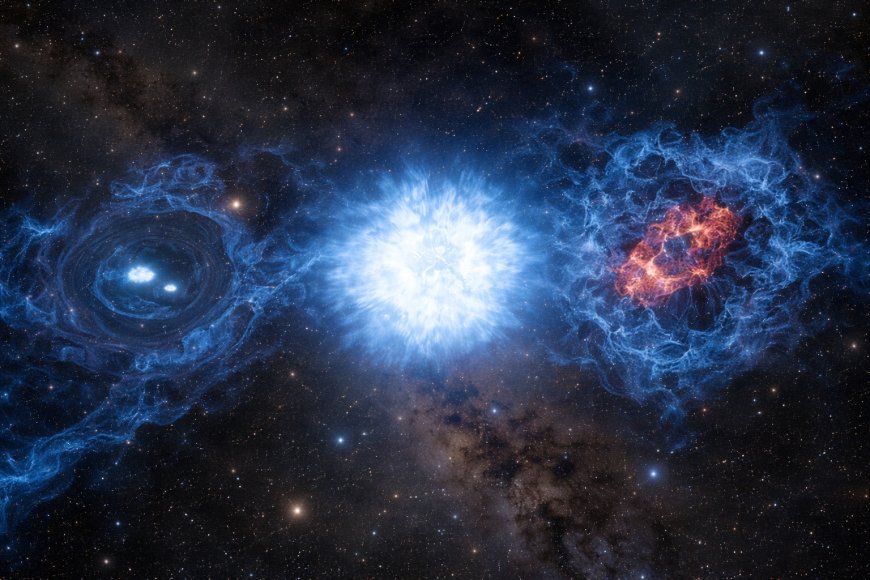
Washington: Astronomers have reported what could be the first known observation of an extremely rare cosmic phenomenon known as a “superkilonova,” following the detection of an unusual gravitational wave signal on August 18, 2025. While scientists caution that the evidence is not yet conclusive, the event has opened a new window into how some of the universe’s most violent explosions may unfold.
A kilonova occurs when two neutron stars—ultra-dense remnants left behind after massive stars explode—collide and merge. These events are of profound scientific importance because they create conditions powerful enough to forge heavy elements such as gold and silver. Until now, astronomers have confirmed only one such event: GW170817, detected in 2017 by the Laser Interferometer Gravitational-wave Observatory (LIGO) and its European counterpart, Virgo.
The newly detected signal, designated AT2025ulz, initially appeared to be just the second confirmed neutron star merger. After LIGO and Virgo detected the gravitational waves, telescopes around the world were alerted. The Zwicky Transient Facility (ZTF) at California’s Palomar Observatory quickly identified a rapidly fading red glow located about 1.3 billion light-years away, consistent with the gravitational wave source.
“For the first few days, the event looked remarkably similar to the 2017 kilonova,” said Mansi Kasliwal, lead author of the study and professor of astronomy at the California Institute of Technology. However, the situation soon became more complex. After initially dimming, the object began to brighten again and shift toward blue wavelengths, showing hydrogen emissions—classic signatures of a supernova, not a kilonova.
This unexpected behavior led scientists to hypothesize a superkilonova, a long-theorized but never-before-observed event. In this scenario, a massive star first explodes as a supernova, forming two neutron stars instead of one. These neutron stars then spiral inward and merge, producing both gravitational waves and a kilonova-like glow—partially hidden by debris from the earlier supernova.
Further analysis revealed another intriguing clue: the gravitational wave data suggested that at least one of the neutron stars involved had a mass smaller than the Sun, which is unusual. This supports theoretical models in which rapidly spinning stars can form pairs of unusually light neutron stars.
Despite the excitement, researchers stress that more data is needed. “We do not know with certainty that we found a superkilonova,” Kasliwal said, “but the event is nevertheless eye-opening.”
Future observations from facilities such as the Vera Rubin Observatory, NASA’s Nancy Grace Roman Space Telescope, and other upcoming projects may soon confirm whether superkilonovas truly exist—or reveal even stranger cosmic surprises.
(Image credit: Caltech/K. Miller and R. Hurt (IPAC))
What's Your Reaction?