
























2026: A Turning Point Year for Humanity’s Journey Into Space
2026: A Turning Point Year for Humanity’s Journey Into Space

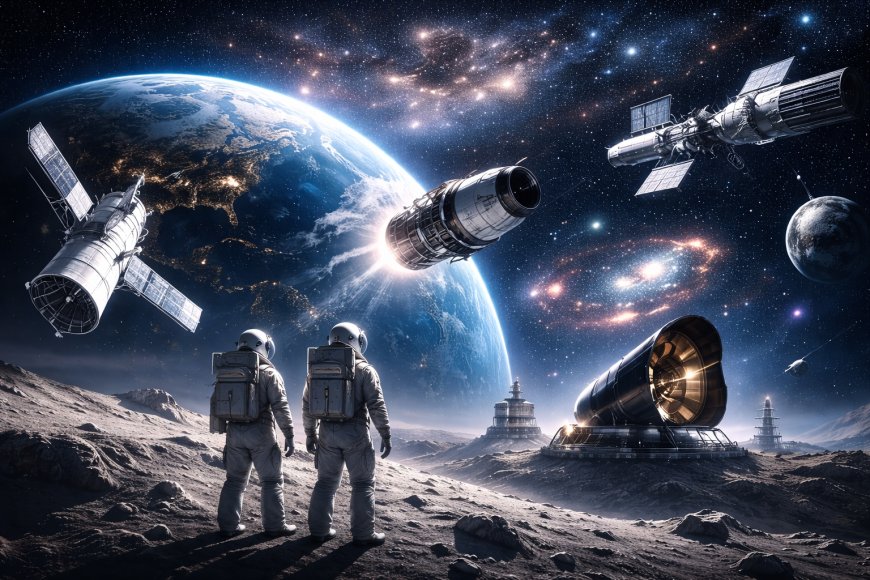
Sriharikota: The year 2026 is set to become a historic milestone in space exploration, marking a decisive shift in how humanity studies, explores and prepares to inhabit the universe. From astronauts orbiting the Moon for the first time in over five decades to powerful new telescopes mapping billions of galaxies, this year will witness an extraordinary convergence of human ambition, scientific discovery and global cooperation.
One of the most anticipated events of 2026 is NASA’s Artemis II mission, scheduled for launch as early as April. For the first time since the Apollo era ended in 1972, astronauts will travel beyond low Earth orbit, undertaking a 10-day journey around the Moon. While no landing is planned, the mission will test spacecraft systems and human endurance, paving the way for sustained lunar exploration later in the decade.
Running parallel to this renewed push for human spaceflight is a revolution in space science driven by next-generation telescopes. Chief among them is NASA’s Nancy Grace Roman Space Telescope, now fully assembled and potentially launching as early as fall 2026. With a field of view nearly 100 times larger than Hubble’s, Roman will survey vast swathes of the sky, mapping billions of galaxies, probing dark matter and dark energy, and discovering tens of thousands of distant exoplanets. Its advanced coronagraph will also help scientists directly image planets around nearby stars, laying the groundwork for future searches for life.
Europe and China are making equally ambitious strides. The European Space Agency’s PLATO mission, set for launch in December 2026, will study around 200,000 stars to identify Earth-like planets in habitable zones while precisely determining stellar ages. China, meanwhile, is preparing to launch Xuntian, its first flagship astrophysics space telescope. Designed to co-orbit with the Tiangong space station, Xuntian will combine Hubble-level image quality with a vastly wider field of view, enabling long-term, serviceable observations of the evolving universe.
Human spaceflight ambitions are also expanding beyond the traditional space powers. India, through its Gaganyaanprogramme, plans a series of uncrewed test flights in 2026, moving closer to becoming the fourth nation to independently send humans to space. China will continue regular crewed missions to its space station, steadily building expertise for future lunar missions.
Planetary science will advance alongside these efforts. Japan’s Martian Moons eXploration mission will begin its journey to study Phobos and Deimos, while China’s Chang’e-7 will explore the Moon’s south pole, searching for water ice critical to future human activity. At the same time, missions like SMILE—a joint European-Chinese solar observatory—will deepen understanding of space weather that directly affects Earth.
Taken together, the missions of 2026 reflect both rivalry and remarkable collaboration. As nations compete technologically, scientists continue to share data and discoveries, united by a common goal: understanding the universe and humanity’s place within it. In that sense, 2026 will not just expand our cosmic horizons—it will redefine them.
What's Your Reaction?